


Industrial Flow Measurement Solutions in Cincinnati, OH
Accurate flow data affects far more than a number on a control-room display. It influences product formulation, utility costs, mass balance, process safety, energy efficiency, and the quality of decisions operators make every day. At M. L. Johnson Company, we provide industrial flow measurement solutions in Cincinnati, OH, for plants that need dependable measurement across liquids, gases, steam, chemicals, and abrasive process media.
Since 1964, our engineering team has helped facilities throughout the Ohio Valley select, configure, integrate, verify, and support industrial flow meters based on actual fluid dynamics and installation conditions rather than simply matching a meter to pipe diameter. As an experienced industrial instrumentation supplier, we focus on measurement accuracy, fluid behavior, and long-term reliability.
Flow Meter Selection Starts With the Fluid and the Process
There is no single flow technology that performs best in every application. Conductivity, viscosity, density, Reynolds number, line pressure, temperature, entrained gas, available straight-run piping, and required accuracy can all change which meter is the right choice. A technology that performs extremely well on clean conductive water may be unsuitable for hydrocarbons, low-flow chemical dosing, saturated steam, or a slurry containing suspended solids.
Our process begins by evaluating those operating conditions in detail. We look at minimum, normal, and maximum flow rates, pressure and temperature ranges, process chemistry, piping geometry, and control objectives before recommending a meter. That technology-agnostic approach allows us to choose from Coriolis, magnetic, ultrasonic, vortex, differential pressure, and other measurement principles without forcing an application into a preferred product category.
Engineered Flow Measurement Capabilities
 Coriolis Flow Measurement for Mass and Density
Coriolis meters are often a strong choice when direct mass flow measurement, density information, or high repeatability is critical. They can be particularly useful in batching, blending, chemical feed, inventory, and other applications where a small flow error can affect product quality or material accountability.
Coriolis Flow Measurement for Mass and Density
Coriolis meters are often a strong choice when direct mass flow measurement, density information, or high repeatability is critical. They can be particularly useful in batching, blending, chemical feed, inventory, and other applications where a small flow error can affect product quality or material accountability.
We evaluate pressure drop, fluid density, viscosity, entrained gas, installation orientation, and expected flow range before specifying Coriolis technology. Although Coriolis meters are highly capable, they still need to be applied correctly, especially where piping stress, two-phase flow, vibration, or very large line sizes may influence performance or project economics.
 Magnetic Flow Meters for Conductive Liquids
Magnetic flow meters are widely used in water, wastewater, chemical processing, and slurry applications because they provide obstruction-free measurement with no moving parts in the flow stream. For conductive liquids, they can offer stable measurement with relatively low pressure loss and good performance across a broad range of flow conditions.
Magnetic Flow Meters for Conductive Liquids
Magnetic flow meters are widely used in water, wastewater, chemical processing, and slurry applications because they provide obstruction-free measurement with no moving parts in the flow stream. For conductive liquids, they can offer stable measurement with relatively low pressure loss and good performance across a broad range of flow conditions.
Application details still matter. Conductivity, grounding, empty-pipe conditions, coating potential, velocity, liner compatibility, and electrode material all need to be considered. We help select appropriate linings and wetted materials, including PTFE, PEEK, Hastelloy, Titanium, and other options when the process requires additional corrosion or abrasion resistance.
 Ultrasonic Flow Measurement When Piping Access Matters
Ultrasonic technologies can be useful for both permanent installations and applications where cutting into the process line is undesirable. Clamp-on systems may also provide a practical option for temporary verification, troubleshooting, energy studies, or facilities that cannot easily shut down piping for meter installation.
Ultrasonic Flow Measurement When Piping Access Matters
Ultrasonic technologies can be useful for both permanent installations and applications where cutting into the process line is undesirable. Clamp-on systems may also provide a practical option for temporary verification, troubleshooting, energy studies, or facilities that cannot easily shut down piping for meter installation.
We evaluate pipe material, wall thickness, fluid properties, acoustic conditions, straight-run availability, and potential entrained gas before recommending ultrasonic measurement. Those variables are especially important because poor acoustic coupling, buildup, bubbles, or flow-profile distortion can significantly affect performance if the application is not reviewed carefully.
 Vortex and Differential Pressure for Steam and Gas Applications
Steam, gas, and high-temperature utility systems often require a different measurement strategy than liquid process lines. Vortex and differential-pressure technologies can be effective in these applications when they are sized around velocity, density, pressure, temperature, and expected turndown.
Vortex and Differential Pressure for Steam and Gas Applications
Steam, gas, and high-temperature utility systems often require a different measurement strategy than liquid process lines. Vortex and differential-pressure technologies can be effective in these applications when they are sized around velocity, density, pressure, temperature, and expected turndown.
We pay close attention to process state because steam quality and phase changes can introduce meaningful error. For DP systems, primary-element sizing, impulse lines, transmitter range, and compensation also matter, while vortex applications require appropriate velocity and Reynolds-number conditions to maintain a stable signal.
 Custody Transfer and Utility Metering
Flow measurement becomes especially sensitive when the reading is used to allocate cost, reconcile mass balance, or support custody-transfer transactions. A small percentage of error multiplied across large volumes of natural gas, steam, water, fuel, or process material can become a significant financial issue over time.
Custody Transfer and Utility Metering
Flow measurement becomes especially sensitive when the reading is used to allocate cost, reconcile mass balance, or support custody-transfer transactions. A small percentage of error multiplied across large volumes of natural gas, steam, water, fuel, or process material can become a significant financial issue over time.
We provide process flow measurement solutions for utility accounting, mass balancing, steam-plant monitoring, natural gas measurement, and custody-transfer applications where accuracy and repeatability are important. Depending on the service, we can help evaluate meter technology, compensation requirements, calibration needs, installation effects, and communications so the measurement can be used confidently for operational and accounting purposes.
Straight-Run Piping and Flow Profile Matter
A meter may be perfectly calibrated and still produce poor readings if it is installed in the wrong hydraulic environment. Elbows, control valves, pumps, reducers, tees, and partially open valves can distort the velocity profile, introduce swirl, or create turbulence that affects measurement accuracy.
Our fluid-dynamic review goes beyond nominal pipe size. We consider line velocity, Reynolds number, upstream and downstream straight-run requirements, flow conditioners, thermal expansion, and nearby piping components so the meter sees a flow profile compatible with its measurement principle. When ideal straight-run lengths are not available, we can evaluate alternative technologies or installation strategies rather than assuming the published accuracy will automatically apply.
 Harsh Media Require the Right Wetted Materials
Corrosive chemicals, abrasive slurries, high-velocity steam, and aggressive process fluids can shorten meter life quickly when materials are chosen poorly. The correct liner, electrode, sensor body, or wetted component should be selected based on both chemistry and mechanical exposure.
Harsh Media Require the Right Wetted Materials
Corrosive chemicals, abrasive slurries, high-velocity steam, and aggressive process fluids can shorten meter life quickly when materials are chosen poorly. The correct liner, electrode, sensor body, or wetted component should be selected based on both chemistry and mechanical exposure.
We work with specialized materials such as PTFE, PEEK, Hastelloy, and Titanium where process conditions justify them. Our goal is not simply to specify the most corrosion-resistant material available, but to balance compatibility, abrasion resistance, temperature, pressure, expected service life, and project cost around the actual process.
 Accounting for Entrained Gas, Pulsation, and Phase Change
Some of the most persistent flow problems are caused by conditions that are easy to overlook during initial design. Entrained air can disrupt liquid measurement, pulsating pumps can create unstable flow profiles, flashing can change fluid state through the meter, and two-phase flow can produce large errors in technologies designed for single-phase service.
Accounting for Entrained Gas, Pulsation, and Phase Change
Some of the most persistent flow problems are caused by conditions that are easy to overlook during initial design. Entrained air can disrupt liquid measurement, pulsating pumps can create unstable flow profiles, flashing can change fluid state through the meter, and two-phase flow can produce large errors in technologies designed for single-phase service.
We evaluate these process behaviors before equipment selection and again during troubleshooting when an existing meter is underperforming. The solution may involve changing meter technology, relocating the measurement point, modifying piping, adding damping or conditioning, or addressing the process condition creating the instability.
Onsite Field Support & Technical Services
Onsite Engineering Support Across the Tri-State Area
Some applications cannot be specified effectively from a datasheet or email alone. Vessel geometry, piping, mounting restrictions, process conditions, and existing instrument behavior may need to be examined in the field before the right solution becomes clear.
Read More
We provide onsite assessments, calibration support, and commissioning assistance throughout Greater Cincinnati, Northern Kentucky, and the surrounding industrial corridor. Our local presence gives facilities access to experienced engineering support without relying entirely on remote troubleshooting when a production-critical measurement point needs attention.
Calibration, Commissioning, and Startup Support
Proper commissioning is where instrumentation theory meets actual operating conditions. Even correctly selected equipment can perform poorly if scaling, mounting, damping, alarm thresholds, or communication parameters are wrong during startup.
Read More
We support field calibration verification, configuration, wiring review, and commissioning so devices are prepared to operate as intended within the larger control strategy. Our technical support continues after startup, giving maintenance and I&C teams a local resource when process conditions change or troubleshooting becomes necessary.
Safety and Hazardous-Area Considerations
Level instrumentation may operate in areas where flammable gases, vapors, dusts, or process hazards require additional engineering attention. We help customers evaluate products with appropriate hazardous-area certifications, including Class I, Division 1 or Division 2 requirements when applicable to the installation.
Read More
We can also support projects where SIL-rated equipment or safety-instrumented system considerations influence device selection. Product certification, installation practice, loop design, and site-specific safety requirements must all be reviewed together, so we focus on selecting instrumentation that aligns with the facility’s engineering and compliance framework rather than making assumptions based on a single specification.
Local Inventory and Reduced Downtime
When a critical level transmitter fails, long lead times can turn a maintenance issue into an extended production problem. Access to appropriate replacement equipment and knowledgeable local support can significantly reduce the time spent diagnosing, sourcing, and commissioning a replacement.
Read More
M. L. Johnson Company maintains access to critical instrumentation and regional engineering resources to help customers respond quickly when measurement problems affect operations. Because we already understand many of the applications and facilities we support, we can often move directly into technical evaluation instead of starting with basic discovery.
PLC Integration, On-Site Support & Verification
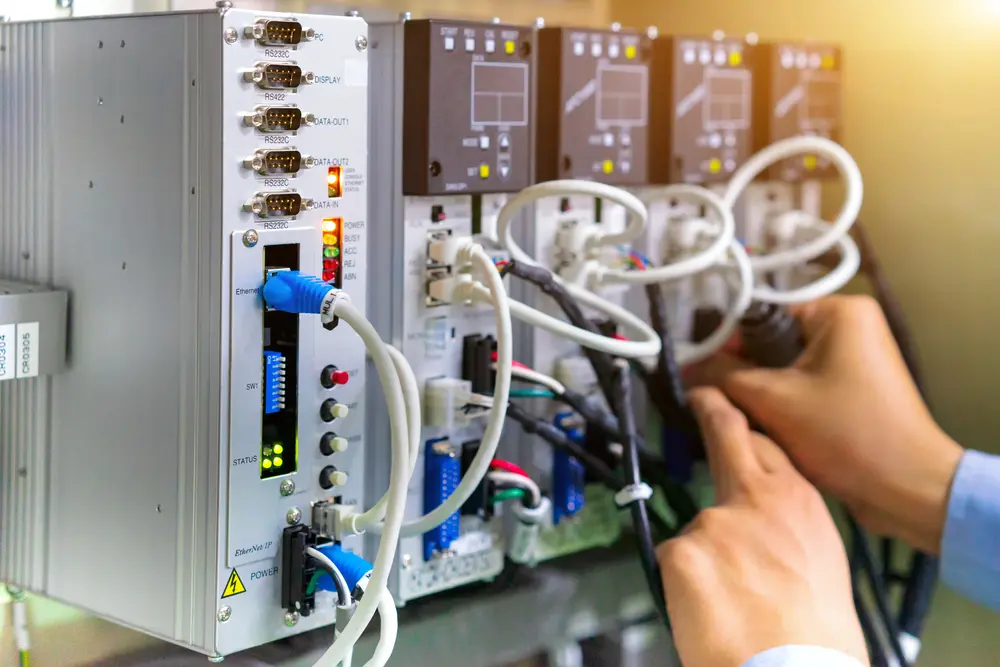
PLC, SCADA, and DCS Integration
A flow meter is only useful if its data reaches the control system reliably. We support integration using common industrial outputs and protocols, including 4-20 mA HART, Modbus, Profibus, and Ethernet/IP where supported by the selected instrumentation.
Read More
Our team can assist with signal configuration, scaling, communication parameters, totalization, diagnostics, and commissioning. By addressing communications during the engineering phase, we help reduce data dropouts and startup delays after the meter has already been installed.
On-Site Verification and Calibration Support
Even well-selected flow meters need periodic verification to maintain confidence in their readings. Zero shifts, buildup, transmitter changes, process modifications, or gradual sensor drift can affect accuracy over time, particularly in critical billing, batching, or regulatory applications.
Read More
We provide local field support for in-line verification, zero-point adjustments, troubleshooting, and annual calibration needs. NIST-traceable calibration support is also available for applicable instrumentation, helping maintenance and quality teams maintain documented measurement confidence.
Why Plant Teams Choose M. L. Johnson Company
We have served industrial customers since 1964, giving us more than 60 years of experience with flow, level, pressure, temperature, analytical instrumentation, control valves, and automation. And as a regional flow meter supplier, we bring application engineering into every recommendation rather than relying on brand preference or catalog defaults.
That combination of technology breadth and local support allows us to address both new applications and difficult existing installations throughout Cincinnati, Northern Kentucky, and the broader Ohio Valley industrial corridor.
Our flow capabilities include:
- Coriolis flow meters
- Magnetic flow meters
- Ultrasonic flow measurement
- Vortex meters
- Differential-pressure flow systems
- Steam and gas measurement
- Utility and custody-transfer metering
- Corrosive and abrasive-media applications
- Flow verification and calibration support
- 4-20 mA HART integration
- Modbus, Profibus, Ethernet/IP communication
- On-site troubleshooting and commissioning
We evaluate fluid type, viscosity, conductivity, density, Reynolds number, pressure, temperature, flow range, piping layout, and accuracy requirements. Those factors help us determine whether Coriolis, magnetic, ultrasonic, vortex, DP, or another technology is the best fit.
Yes. We review upstream and downstream disturbances, available pipe length, flow profile, and meter sensitivity before recommending an approach. Alternative technologies or flow-conditioning strategies may be used when ideal straight runs are not available.
Yes, we support aggressive and abrasive applications using appropriate liner and wetted-material options such as PTFE, PEEK, Hastelloy, or Titanium. Final material selection depends on chemistry, temperature, pressure, and erosion conditions.
Yes. We support applicable communication methods including 4-20 mA HART, Modbus, Profibus, and Ethernet/IP, along with configuration and commissioning assistance.
Yes, we provide field verification, zero-point adjustments, troubleshooting, and calibration support for applicable instruments. NIST-traceable calibration documentation can also support quality and maintenance programs.
Yes, we engineer flow measurement for steam, natural gas, and other utility services. We evaluate pressure, temperature, density, compensation, turndown, and installation effects before recommending the measurement technology.
Engineer Flow Measurement Around the Actual Process
Reliable industrial flow measurement requires more than selecting a meter with the right flange size. At M. L. Johnson Company, we combine fluid-dynamic engineering, multiple measurement technologies, harsh-media material expertise, control-system integration, field verification, and more than 60 years of regional experience to help plants achieve accurate, repeatable process data. So whether you’re correcting a troublesome flow point, upgrading utility metering, planning a new production line, or improving custody-transfer accuracy, our team can evaluate the full application and recommend a solution built around real operating conditions. Just contact us today to review your flow measurement requirements and put dependable data into your process.